Wednesday, November 6, 2013

Friday, August 23, 2013
Special food in the Centre Vietnam
Banh beo xu Hue Hue
 Banh beo is a specialty and indispensable in
Bun bo gio heo (Beef and fork soft noodle soup)
 Preparing Bun bo gio heo is very skillful. Pig leg is clean-shaved, chopped into even slices with adequate bone, meat and skin, mixed with lean beefs, and soaked with salt, pepper, fish sauce, dry onion and spices.
Bun bo gio heo is proper with all appetites. Even diet people could enjoy the sweet-smelling of beef with less fat of pig leg so as not to be fed up with as serving. Bun bo gio heo is delicious anytime you have it. You could enjoy this specialty of the Central region on Hue City
Banh la cha tom (Grilled rice cake with Cray fish)
 Anyone who used to experience the dish would never forget such simple cake made from grilled rice cake and Cray fish only.
The cake must be as thin as a leaf but flexible enough. Cray fish must be brittle and sweet. Serving with long jawed anchovy sauce.
Banh la cha tom does not as heavily smell as the majority of the other dishes but gentle, elegant and attractive to customers
Com hen song Huong (Perfume River
 Com hen has a sweet-smelling flavor of rice, onion, and grease, as well as strange tastes of sweet, buttery, salty, sour, bitter, and peppery-hot. You have to arrive to Hen river-islet in the
Com hen is always attractive to many customers because it is tasty and, at the same time, economic to anybody.
Cao lau Hoi An (Hoi An vermicelli)
 Cao lau as a dish has its "own kingdom", therefore, customers are likely to be served with it only in Hoi An.
Cao lau noodles are carefully made from local new rice not stocked one. Water used to soak rice must be taken from wells in the Ba Le Village; noodles thus will be soft, enduring and flavored with special sweet-smelling. In addition, meat used to prepare for Cao lau must be loin or trotter.
Dry pancakes used must be thick and have much sesame. Greasy coconut quintessence and bitter green cabbage are also indispensable. The so-called genuine Cao lau Hoi An must satisfy all above requirements.
Banh trang cuon thit heo (Dry pancake roll with pork)
 Coming to the Central region, you are offered with the service of Banh trang cuon thịt heo.
A big plate of fresh vegetables with a peppery-hot red chilly, a plate of boiled lean and fat meat, a bowl of fish sauce, and a plate of dry pancakes are displayed on the dining table. Customers have to serve themselves with all of the 10 substances mentioned above.
Banh trang cuon thịt heo is considered as not only a daily dish but also likely an artistic specialty of the Central citizens.
My Quang (Quang soft noodle soup)
 Similar to rice noodle and chicken or pork soup (Hu tieu),My Quang is a variety of Pho (rice noodle soup), because the noodles are made from rice and soused with soup as serving. The soup sauce, which is added, comes from a mixture of flavor from beef or pork bone, shrimps, crabs, chicken and duck. The noodles are yellow, somewhat distinct from Pho. However, the main reason for having this color is to be in hannony with the colors of shrimps and crabs.
The best My Quang is made from rice in Phu Chiem, shrimp in Cho Dai and spicy vegetables in Tra Que. As a strict selection of substances to prepare, My Quang has been dominant in almost all of culinary markets in the Central provinces Ho Chi Minh City
Floating Markets in Mekong Delta
In the Mekong Delta, floating markets comprise of many boats on the river from which people can purchase all kinds of commodities such as foods and other household goods.
 |
| Nga Nam floating market in Soc Trang Province |
The floating markets are held all day long but the most crowded time is during the morning hours from 8 to 9am.
Visitors come to the famous floating markets of Cai Rang in Can Tho Province, Phung Hiep in Hau Giang Province or Nga Nam in Soc Trang Province in the Mekong Delta.
Each floating market has its own characteristics and many visitors go to the floating markets not just to buy things but also to view the daily activities of the Vietnamese people on the river.
These floating markets create interesting tours for both local and foreign tourists.
 | ||||||||
Food services display at floating market
|


The beautiful flowers of Vietnam
Flower production has always been a traditional activity of the Vietnamese and cut flowers are mainly produced by small holders in their garden plots.
 |
An old lady chooses flowers at a street vendor in HCM City
|
The tropical flowers are grown in the southern part of the country while the more delicate blooms require the temperate climate of the mountain region of Dalat.
The Vietnamese people love flowers and no festival or celebration is complete without them, if you are lucky enough to be invited into a Vietnamese home you will see vases of beautiful arrangements in the rooms. In hotel lobbies the works of art that are produced by highly skilled and imaginative florists are a wonderful first impression for the overseas tourists, fuelling the notion of exotic Vietnam.
The markets traditionally have an area dedicated to flowers and bucket loads of wonderful blooms adorn the streets adding color and vibrancy to the street scene. Whether buying or sightseeing it is a therapeutic experience to wander through narrow alleyways lined with a multiplicity of color, softness and above all, perfume. The best time is in the earlier part of the morning when the flowers are at their freshest and before the heat and humidity overpower the fragrances.
Those wanting to view the wonderful array of flowers available should make a trip to the street market in Ho Thi Ky in District 10. The stalls are loaded with varieties of every type of bloom, the lotus flowers are in abundance as are buckets of roses and chrysanthemums, the orchids come in every color of the rainbow and the gladioli stand majestically, the most valued being the deep red. A large bouquet of flowers can be selected for a very reasonable price. It seems that flowers bloom everywhere in Ho Chi Minh City along the streets of the city and suburbs, the subtle shades of the classical orchid, the piquant purple pansy and the boldly wild sunflower.
Dalat (the name is derived from the pine woods for which it is famous) is the place to visit if you want to see more of the magnificence of Vietnam’s plant life and blooms and the best time to go is in the early spring, during the Flower Festival which is held in early January. The blues and pinks of the hydrangeas in season are startling. The peach trees, in blossom near Xuan Huong Lake, are a particularly beautiful sight. They used to grow in forests around the city but, unfortunately, most of them have now been cut down. Then there is the yellow Mimosa from Australia and the flamboyant purple of the Brazilian Jacaranda trees.
For people who live and work in the City it is uplifting to see the natural beauty of flowers decorating the streets and markets, take time to see beyond the stress of the man-made environment. Enjoy the fragrances, the color, the shapes and the delicacy, your soul will be more content for the rest of the day.
By Ann Wheaton
Thursday, August 22, 2013
Travel feel at home in Ninh Binh
Ninh Binh Province is promoting tourism homestays and
improving co-operation with other provinces to enhance the tourism
experience, says provincial Department of Culture, Sports and Tourism
deputy director Duong Thi Thanh.
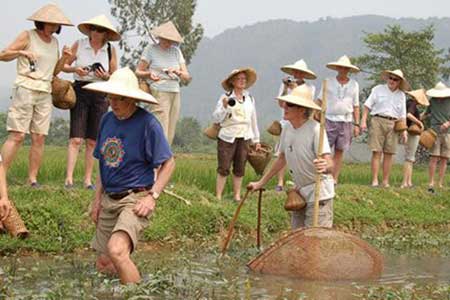 |
| Grey nomad trail: Tourists enjoy outdoor activities during their homestay tour in Van Long District in Ninh Binh Province. |
Tourists in homestay accommodation take part in the family's daily activities, like going to the market, cooking and farming
The nation's current tourism strategies favours green tourism which Thanh said was associated with the preservation of eco- diversity and natural values.
In ties with other regions, Ninh Binh had signed a 2012 development and co-operation agreement with 10 provinces and cities with high tourism potential, including Ha Noi, HCM City, Da Nang, Thua Thien-Hue, Quang Nam, Can Tho, Quang Ninh, Hai Phong, Lao Cai, and Lang Son.
Thanh said the ties would assist tours of ancient capitals, including Hoa Lu in Ninh Binh, Thang Long citadel (Ha Noi), Lam Kinh vestige, Ho citadel (Thanh Hoa Province) and Hue City.
The provincial tourism section head, Hoang Thanh Phong said: "The province also has craft villages like Van Lam embroidery village, Ninh Van stone carving village of Hoa Lu District, and Kim Son sedge village in Kim Son District.
"When craft villages are better known, it could help create jobs for local people."
However, Ninh Binh still faced challenges, including the perception of poor environmental protection, site information and professionalism among tourist guides, along with annoying street vendors and a lack of entertainment, Thanh said.
"Employees in tourism activities will undergo training in environment protection, languages, culture and history."
Recently, Gia Sinh Commune in Gia Vien District opened the club Lang Am Thuc De Nui (Gastronomy Village of Mountain Goat). There, 20 members made a commitment to strictly observe food service regulations and to make sure prices were included on menus.
Located 93km south of Ha Noi, Ninh Binh has diverse landscapes, with the Trang An ecotourism complex boasting mountains, caves and lakes.
Among 3.6 million visitors to the province in the first six months of this year, 2.5 million went to the complex.
The Tam Coc-Bich Dong tourist destination and Bai Dinh Pagoda have also created an impression.
Ninh Binh aims to welcome 6 million visitors, including 1 million foreigners, by 2015, an annual growth rate of 10 per cent.
Festival to promote Hanoi’s craft village tourism
 More than 400 stalls will be set up to present tourism programmes,
culinary culture and products of traditional craft villages of Hanoi and Red River Delta provinces during a
festival in the capital city from October 9–12. More than 400 stalls will be set up to present tourism programmes,
culinary culture and products of traditional craft villages of Hanoi and Red River Delta provinces during a
festival in the capital city from October 9–12.
Visitors
have the chance to observe artisans at work and try their hand at making some
products.
Several
forms of folk culture like water puppetry, calligraphy and “ca tru” singing
will also be introduced along with tours around craft villages in Hanoi.
Apart
from these activities, the Hanoi city People’s
Committee will discuss measures to develop craft village tourism in Hanoi with participating
scientists, artisans, travel agencies and representatives of international
organisations.
As
part of the 2013 National Tourism Year of the Red River Delta–Hai Phong, the
event aims to honour, conserve and develop traditional craft villages in the
region.
|
Tuesday, August 20, 2013
Second Da Lat in Central Highlands
Also with cold weather, pine forests and mansions nestled in the
morning dew, Mang Den is like the second Da Lat city in the majestic
forest and mountain of Central Highlands.
In
the language of Bana people, Mang Den means the large and flat land.
Located at an altitude of 1,200 m over the sea level, Mang Den becomes
the ideal place to hide the heat and wind of the Central Highland, with
an average temperature of 18-20 degrees C all the year round. About 50
km to the northeast Kon Tum City, Mang Den has a wild, pure beauty like a
young woman sleeping in the woods.
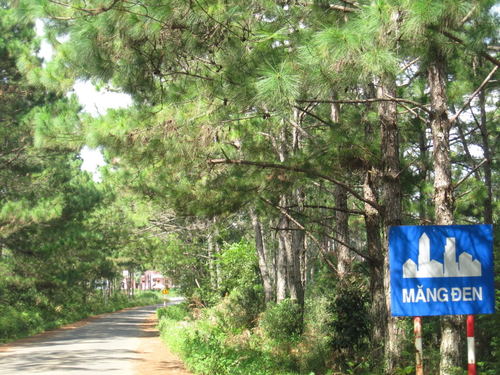
On the basalt trail leading to grandeur Mang Den, anyone would mistake like being lost in the romantic landscape of Da Lat. Located between the winding passes of Mang Den and Violak, Mang Den hides itself in the primitive forests, creating a spectacular natural picture.
Mang Den Pass gives visitors shocking, refreshing feelings before the majestic scenery. Especially in winter, there are times when cloud covers the entire pass. At the peak of the Pass, visitors feel ecstasy by the beauty of the landscape of high mountains, dense forests…
While rare red pine trees are disappearing in Da Lat, Mang Den is surrounded by endless stretches of red pines. Mixed in that vast blue are songs of the forest, which are harmonized the sounds of waterfalls, water and birds.
Tourists
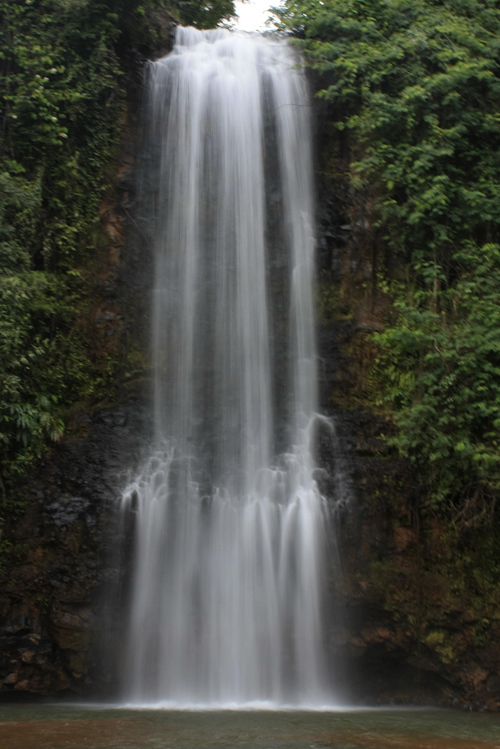
can walk to the waterfall as Pa Sy, Dak Ke, Lo Ba to enjoy the love
songs of the mountains, or simply stroll around the idyllic lakes such
as Toong Zori, Toong Po and Toong Dam to feel the quiet moments in the
nature. If you are adventurous, you can cross the forest watching
blooming orchids.
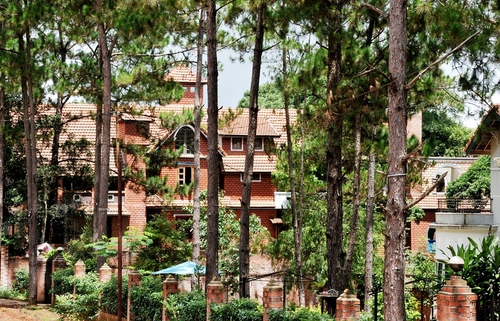
Mang Den also has French style villas like Da Lat. Lovely scenery with fresh air in this place turns this place into an ideal place for those who want to feel relaxed in mind. Here visitors are also immersed in the sounds of gongs and enjoy ruou can (wine drunk out of a jar through pipes) near fire.
Not only linking Kon Tum with Quang Ngai and provinces in the central coast, Mang Den is also seen as the start of the tourist route "Highland Green Road," connecting to the "Central Region Heritage Route" and the "Ho Chi Minh legendary road" to form the trans-nation tours. These traits are enough to make Mang Den’s own place in the heart of tourists, not only known as a “shadow” of Da Lat city.
The pine trees in Mang Den.
On the basalt trail leading to grandeur Mang Den, anyone would mistake like being lost in the romantic landscape of Da Lat. Located between the winding passes of Mang Den and Violak, Mang Den hides itself in the primitive forests, creating a spectacular natural picture.
Mang Den Pass gives visitors shocking, refreshing feelings before the majestic scenery. Especially in winter, there are times when cloud covers the entire pass. At the peak of the Pass, visitors feel ecstasy by the beauty of the landscape of high mountains, dense forests…
While rare red pine trees are disappearing in Da Lat, Mang Den is surrounded by endless stretches of red pines. Mixed in that vast blue are songs of the forest, which are harmonized the sounds of waterfalls, water and birds.
The magical beauty of Pa Sy waterfall. Photo: kontum.org.vn.
French villas in Mang Den. Photo: kontum.org.vn
Mang Den also has French style villas like Da Lat. Lovely scenery with fresh air in this place turns this place into an ideal place for those who want to feel relaxed in mind. Here visitors are also immersed in the sounds of gongs and enjoy ruou can (wine drunk out of a jar through pipes) near fire.
Not only linking Kon Tum with Quang Ngai and provinces in the central coast, Mang Den is also seen as the start of the tourist route "Highland Green Road," connecting to the "Central Region Heritage Route" and the "Ho Chi Minh legendary road" to form the trans-nation tours. These traits are enough to make Mang Den’s own place in the heart of tourists, not only known as a “shadow” of Da Lat city.
Subscribe to:
Posts (Atom)